
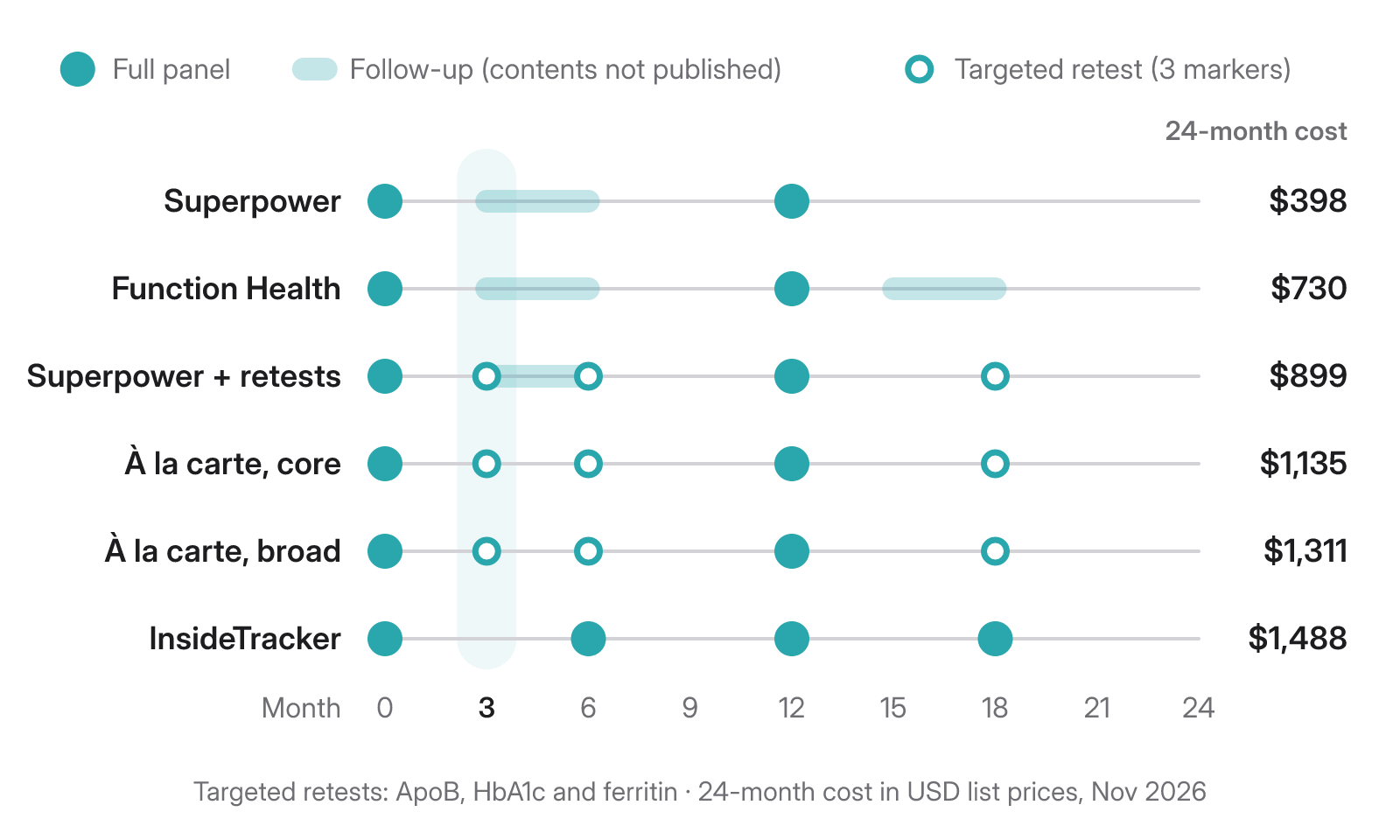
At list prices on 20 November 2026, two years of Superpower ($398) or Function Health ($730) cost the least. They also test far more markers. Buying a full panel and targeted retests yourself costs $1,135 to $1,311. What à la carte buys is timing. Your flagged markers get rechecked at month 3, when a change can first show, not at the next scheduled draw.
Prices, providers and insurance rules here are all US ones. In Canada, read Longevity testing in Canada instead.
The short version
- Lowest cost and broadest panel: Superpower ($398) or Function Health ($730).
- Month-3 rechecks at the lowest cost: Superpower plus targeted retests ($899).
- Insurance covers your full panels: à la carte. You pay cash only for the three retests, $501 in this example.
- A clinician reviews every result: Function Health.
These totals buy very different amounts of testing. The totals aren’t like for like explains what that means for a healthy adult.
Why this matters
Say your first full panel comes back mostly fine, with three markers you’d like to move. You’ll change something, such as diet, training, a supplement or a medication your clinician suggests. Then you want to know whether it’s working.
Memberships test dozens of markers, up to 160+, on a fixed cycle. À la carte means you buy a full panel now and then, and only the flagged markers in between. The two approaches cost different amounts, and they answer the “is it working?” question at different times.
The worked example
A healthy adult whose baseline panel flags three markers:
- ApoB above the longevity target. Read: Why our ApoB target is 0.65, not 0.55.
- Ferritin low, a sign of low iron stores. Read: Ferritin 15 or 30?
- HbA1c in the prediabetes range, which NIDDK defines as 5.7 to 6.4% (39 to 46 mmol/mol).
We chose these three because each can change with diet, lifestyle or treatment. Each is also sold as a single test, and each moves at a different speed. We left out vitamin D, a common flag. The Endocrine Society’s 2024 guideline suggests against routine vitamin D testing, so retesting it often is hard to justify. Read: Your “optimal” vitamin D range was retired.
How long each marker takes to respond
Retest too soon and the result can’t show the change yet.
| Marker | When a change can show | Source |
|---|---|---|
| ApoB | 4 to 12 weeks after a change, then every 3 to 12 months as needed | 2018 AHA/ACC cholesterol guideline |
| Ferritin | In a trial of women with low ferritin but no anaemia, ferritin had risen after 12 weeks of oral iron. The authors suggest a first check at 6 weeks | Vaucher et al. (2012), CMAJ |
| HbA1c | Reflects average blood sugar over about the past 3 months | NIDDK |
The cholesterol guideline is written for LDL cholesterol. ApoB is measured on the same particles, so we apply the same window. The 2021 British Society of Gastroenterology iron guideline covers iron-deficiency anaemia. For low ferritin without anaemia, it calls the benefit of iron treatment unclear. So the ferritin row uses a trial in women without anaemia.
Month 3 falls within the ApoB window and spans the 3 months HbA1c reflects. It also matches the trial’s 12-week point, when ferritin had risen. So the à la carte plan retests them at months 3, 6 and 18, with a full panel at months 0 and 12. The year-one full panel rechecks the markers that were fine at baseline.
Two years, side by side
| Markers per full draw | ApoB / HbA1c / ferritin | Draws in 24 months | First recheck of the 3 markers | Clinician review | 24-month cost | |
|---|---|---|---|---|---|---|
| Superpower | 100+ | Yes / Yes / Not stated¹ | 2 full (months 0, 12) + 1 new-member follow-up (months 3 to 6) | Follow-up at months 3 to 6, if it covers them²; else month 12 | Care team | $398 |
| Function Health | 100+ at the yearly draw, 60+ at the follow-up (160+ a year) | Yes / Yes / Yes | 2 full (months 0, 12) + 2 follow-ups (3 to 6 months after each) | Follow-up at months 3 to 6, if it covers them²; else month 12 | Clinicians review every result | $730 |
| Superpower + targeted retests | 100+ | Yes / Yes / Not stated¹; all three at retests | 2 full + 3 targeted | Month 3 | Care team for full panels | $899 |
| À la carte, core panel (Labcorp) | Not stated for the $189 test, plus ApoB and ferritin | Yes / Yes / Yes | 2 full + 3 targeted (months 3, 6, 18) | Month 3 | Order approval by an independent physician | $1,135 |
| À la carte, broad panel (Quest Elite + Labcorp) | 85+ | Yes / Yes / Yes | 2 full + 3 targeted | Month 3 | Results discussion with an independent provider | $1,311 |
| InsideTracker, 2 tests a year | Up to 54 | Not stated¹ / Not stated¹ / Not stated¹ | 4 full (months 0, 6, 12, 18) | Month 6 | Platform recommendations | $1,488 |
¹ The provider’s page doesn’t name this marker, so treat it as unconfirmed: the option may not cover it.
² The follow-up’s contents aren’t published, so it may not include all three markers.
Verith Pro is a tracking app for your results, not a test, so it isn’t an option in this table. It costs US$69.99 a year (CA$89.99), or $139.98 (CA$179.98) over 24 months. That’s on top of any option above. A free tier covers importing, standard ranges and trends.
Assumptions. List prices from each provider’s own page, accessed 20 November 2026, in US dollars, with year two priced like year one. Marker counts and lists come from the same pages, read 21 November 2026. Sales, taxes and insurance are left out. Three assumptions matter most:
- Unnamed markers are unconfirmed. Superpower lists “Iron Studies” but doesn’t name ferritin. InsideTracker’s store pages name no markers; its June 2024 biomarker list names all three. Confirm the exact list with the provider before you buy.
- Follow-ups may not recheck your markers. Superpower and Function say to take the follow-up 3 to 6 months after a full draw. Neither lists what it includes.
- The à la carte full panel is our choice. The core plan uses Labcorp’s $189 Comprehensive Health Test, plus ApoB and ferritin: $317. That test covers a metabolic panel, blood count, urinalysis, lipids and HbA1c. The broad plan uses Quest’s Elite Health Profile instead.
The rest of the pricing:
- Superpower: $199 a year, which may vary in New York and New Jersey. The new-member follow-up is valued at $99.
- Function Health: $365 a year, two draws plus on-demand testing.
- InsideTracker: $761 for membership with two Ultimate tests in year one. Year two is the $149 renewal plus $578 for two member-priced tests.
- Targeted retest (Labcorp OnDemand): ApoB $69, ferritin $59 and HbA1c $39, so $167 per draw. Labcorp says physician services are included in each price. Retests cover only these three markers.
- Quest Elite Health Profile: 85+ markers including ApoB, ferritin and HbA1c, at $399 plus a $6 physician service fee.
The totals aren’t like for like
These totals compare different amounts of testing. Per full draw, InsideTracker tests up to 54 markers, and Superpower and Function 100 or more. The à la carte core plan covers a basic panel plus the three markers.
Does a healthy adult need the extra coverage? US screening advice is narrower. The US Preventive Services Task Force recommends screening for prediabetes and type 2 diabetes in adults 35 to 70 with overweight or obesity. For statin decisions in adults 40 to 75, it uses a heart-risk estimate that includes cholesterol levels.
Broad check-ups have little outcome evidence. A Cochrane review looked at general health checks, which screen for several diseases or risk factors at once. It found that they “have little or no effect on the risk of death from any cause.” The authors add that offering them “may lead to unnecessary tests and treatments.”
More markers also mean more flags by chance. Labs usually set a reference range to include 95% of healthy people. On a 20-test panel, only about 36% of healthy people would have every result in range.
Broader testing makes more sense with a reason: a symptom, a known condition, or a clinician’s request. Then the extra markers answer a specific question.
Why faster feedback helps
Each recheck answers one question: is the change working? A month-3 result gives you, and your clinician, time to adjust: a different diet, a different iron dose, or a conversation about medication. On a 6- or 12-month cycle, a change that isn’t working can run that much longer before anyone sees it.
Targeted tests also keep the noise down. Each extra marker is another chance of a result just outside a range by chance. Read: Do you need the full panel every time?
What memberships do better
Price, for most people in this example. Superpower and Function cost less than paying cash for comparable panels. They include clinician review, a plan, booking and results in one app, and much broader panels: hormones, nutrients, extra heart markers. Function and InsideTracker offer at-home draws. If you want a broad panel twice a year, a membership is usually the better buy.
À la carte comes out ahead on timing, and when insurance pays for part of it. Under the Affordable Care Act, most plans must cover current USPSTF A and B recommendations without cost sharing. That includes diabetes screening from age 35 for adults with overweight or obesity. The Task Force lowered the starting age from 40 in 2021.
HealthCare.gov’s public list still shows diabetes screening for adults 40 to 70. It also lists cholesterol screening “for adults of certain ages or at higher risk.” It notes $0 isn’t guaranteed, so check your plan’s documents. Coverage for ApoB and ferritin varies by plan.
In Canada, the math is different. In Ontario, ApoB, ferritin and HbA1c are insured lab tests when a clinician orders them. Read: Longevity testing in Canada. The LifeLabs Ontario store lists no self-pay ApoB or ferritin test, and sells an at-home A1C kit for CA$65.
What we don’t know
No trial has tested whether more frequent retesting improves health outcomes for healthy adults. The response windows above come from guidelines and a trial in people being treated, not in people tracking markers for longevity. Membership prices and contents change often, and promotions come and go.
What this means for you
Before choosing, list the markers you’re working on and when each one could first show a change. Then ask your clinician which recheck schedule makes sense, and compare what each option costs on that schedule.
Insurance can flip the math. Say your clinician orders both full panels, including ApoB and ferritin, and your plan covers them. Then you pay cash only for the three retests: $501 over two years.
Where Verith fits
Verith puts results from Labcorp, Quest or a membership on one timeline, and saves every original report to your own iCloud Drive. Its AI Coach builds a prompt from your history, to explore diet and lifestyle changes to discuss with your clinician. Many services keep results on their servers, where a breach can expose them; Verith never receives yours, which stay on your iPhone or iCloud.
Not medical advice. Talk to your healthcare provider about your results and your testing schedule.